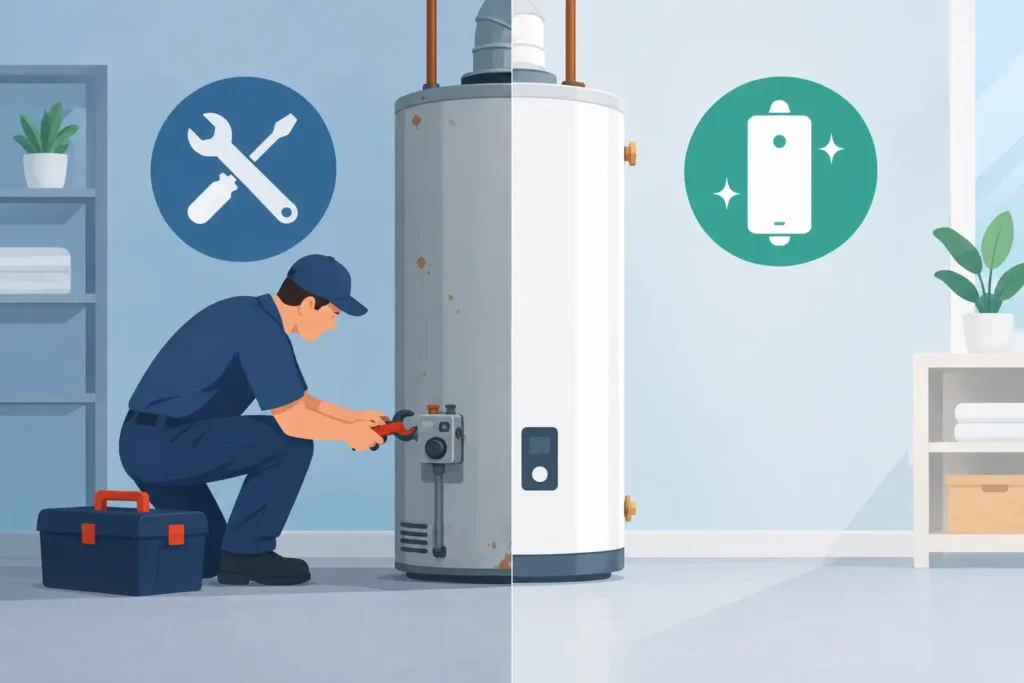
A cold shower is rarely the first sign of trouble. Most water heaters give homeowners in Wesley Chapel and across Tampa Bay a warning first: lukewarm water, a strange popping sound, rusty water at one faucet, or a utility bill that keeps climbing. The question is whether you are looking at a straightforward repair or a water heater that is nearing the end.
The right answer depends on the unit’s age, the type of failure, your household’s hot-water needs, and the condition of the water around it. Florida’s hard water can be especially rough on tank-style systems. A quick, honest diagnosis beats guessing, and it beats paying for a temporary repair on equipment that is ready to fail.
The Signs Your Water Heater Needs Attention
Water heaters work quietly until they do not. If the hot water runs out faster than it used to, starts arriving at inconsistent temperatures, or never gets fully hot, do not assume the tank simply needs more time. The issue may be a failed heating element, a bad thermostat, sediment buildup, a worn burner component, or a tank that has lost efficiency.
Noises matter, too. Popping, crackling, rumbling, and banging often point to mineral sediment sitting at the bottom of a tank. As the burner or heating elements heat the water beneath that layer, trapped steam pushes through it. The system has to work harder, uses more energy, and can overheat the tank bottom over time.
Water around the unit needs prompt attention. Condensation can be normal in some situations, but standing water, drips from the tank body, or corrosion around fittings are not something to ignore. A leaking pressure-relief valve or pipe connection may be repairable. Water coming directly through a rusted tank is a replacement issue. Tanks cannot be safely patched from the outside.
Repair or Replace: The Decision Comes Down to the Details
A repair often makes sense when the water heater is relatively young and the problem is limited to a serviceable part. On an electric unit, that may mean replacing a thermostat or heating element. On a gas unit, the fix could involve the igniter, thermocouple, burner assembly, or gas control valve. A failing expansion tank, pressure-relief valve, or shutoff connection can also be corrected without replacing the whole heater.
Age changes the math. Conventional tank water heaters commonly last around eight to 12 years, although water quality, maintenance, installation quality, and household demand all play a role. If a tank is approaching that range and needs a major part, homeowners should compare the repair cost with the value of installing a new, warrantied system.
Replacement is usually the responsible choice when the tank is leaking, heavily rusted, repeatedly failing, or no longer sized for the household. It also makes sense when the repair is expensive enough that it delays a replacement without solving the underlying problem. The lowest immediate price is not always the lowest cost over the next few years.
A good plumber should explain that trade-off plainly. No scare tactics. No long sales pitch. You should know what failed, what can be repaired, what replacement would involve, and the quoted price before work begins.
Choosing the Right Type of Water Heater
The best unit is not automatically the biggest tank or the most expensive model. It is the system that matches how your home uses hot water.
Tank Water Heaters
A traditional storage-tank water heater keeps a supply of hot water ready for use. It is a practical choice for many Tampa Bay homes because installation is generally straightforward, replacement costs are predictable, and units are available in several capacities.
For a smaller household, a 40- or 50-gallon tank may be enough. Families with multiple bathrooms, teenagers, large soaking tubs, or back-to-back showers may need more capacity. Sizing should account for peak demand, not just the number of people in the home. Two people who shower at different times have very different needs from two people getting ready at the same time every morning.
Gas tank systems usually recover hot water faster than electric models, but the correct choice depends on what fuel service and venting your home already has. Switching from electric to gas is not a simple appliance swap. It may require gas piping, venting changes, permits, and other work that affects the budget.
Tankless Water Heaters
Tankless water heaters heat water as it passes through the unit. They do not store a large reserve, so they can provide hot water for extended periods when properly sized. That makes them appealing for busy households that want consecutive showers without waiting for a tank to recover.
But tankless is not a one-size-fits-all upgrade. The unit must be sized for the incoming water temperature and the number of fixtures likely to run at once. A system that is undersized can struggle when someone showers while the dishwasher and washing machine are running.
Installation can also be more involved than replacing a tank. Gas tankless units may need larger gas lines, new venting, and electrical work. Electric tankless systems can require substantial electrical capacity. They save space and can be very efficient, but upfront cost and annual maintenance should be part of the decision.
Heat Pump Water Heaters
Heat pump water heaters pull heat from the surrounding air to warm the water. They can be highly efficient, especially in Florida’s warm climate, and may lower operating costs for the right home. They also need adequate installation space, produce some noise, and can cool or dehumidify the surrounding area. A garage is often a better fit than a small interior closet.
Hard Water Can Shorten a Water Heater’s Life
Many local homeowners notice hard-water scale on shower doors, faucets, and dishwasher racks. That same mineral buildup settles inside water heaters. In tank systems, it collects at the bottom. In tankless systems, it can form inside the heat exchanger.
Maintenance helps, but the service is different for each type. Tank water heaters benefit from periodic flushing to remove sediment before it becomes a thick, hardened layer. Tankless water heaters need descaling to clear mineral buildup from the internal passages. Skipping these services can reduce efficiency, increase noise, and lead to avoidable component failures.
Maintenance cannot fix a rusted-through tank or reverse years of severe corrosion. It can, however, protect a newer system and help you get more value from the equipment you already own.
Do Not Ignore Safety Warning Signs
A water heater involves high heat, water pressure, electricity, or gas. When something looks wrong, the safest move is usually to stop using it until it can be checked.
Call for help right away if you smell gas, see a yellow or unstable flame on a gas unit, notice soot around the appliance, hear a loud hissing sound, or find active leaking. A leaking tank can damage flooring, drywall, cabinets, and nearby belongings quickly. If the unit is in an attic, garage closet, or interior utility room, the risk of property damage is even higher.
Also pay attention to the temperature-pressure relief valve. This safety device is designed to release water if pressure or temperature becomes too high. It should not be capped, plugged, or ignored because it drips. The cause needs to be identified and corrected.
What a Proper Water Heater Visit Should Include
A water heater service call should be more than a quick glance at the thermostat. The technician should inspect the unit’s age and condition, verify the source of the issue, check connections and safety components, and discuss whether repair is practical. For replacement, the conversation should cover capacity, fuel type, installation requirements, code considerations, warranty options, and the expected final price.
For homeowners in Wesley Chapel, Land O’ Lakes, Lutz, Zephyrhills, Tampa, and nearby communities, fast service matters when hot water disappears. It also matters that the person at your door is the person responsible for the work. H.I.P. Home Service & Drain provides residential water-heater repair, replacement, flushing, and tankless descaling with in-house technicians, upfront pricing, and no call-center runaround.
If your hot water is fading, your tank is making noise, or you see moisture where it should be dry, act before a small warning becomes a flooded utility room. A clear diagnosis now gives you time to choose the right fix instead of making a rushed decision after the heater quits completely.