Your tankless water heater can still make hot water while scale is building inside it. That is what makes skipped maintenance expensive. A tankless water heater descaling service clears mineral deposits from the heat exchanger, where hard water can slowly restrict flow, reduce performance, and put extra strain on a system that is supposed to last for years.
For homeowners in Wesley Chapel and across Tampa Bay, this is not a minor housekeeping task. Florida water often carries enough dissolved minerals to leave buildup on faucets, shower glass, and inside plumbing equipment. A tankless heater heats water fast and efficiently, but its narrow internal passages give that mineral scale a place to collect.
What Scale Does to a Tankless Water Heater
When water is heated, minerals such as calcium and magnesium can separate and cling to hot metal surfaces. Inside a tankless unit, that buildup forms on the heat exchanger. The more scale that accumulates, the harder the heater has to work to transfer heat to the water moving through it.
At first, the change may be subtle. A shower may take longer to warm up, or the water temperature may fluctuate when more than one fixture is running. Later, you may hear a popping, rumbling, or whistling sound from the unit. Some systems begin showing error codes or shut down to protect themselves.
Scale does not always mean the heater has failed. It does mean the unit needs attention before restricted flow or overheating creates a larger repair. Ignoring it can shorten the life of expensive components, especially the heat exchanger.
When to Schedule Tankless Water Heater Descaling Service
Most manufacturers recommend annual maintenance, but the right interval depends on your water quality, household water use, and whether you have a working water softener. A small household with softened water may need service less often. A busy home with hard water, multiple bathrooms, and frequent laundry may benefit from descaling every year.
Do not wait for a complete loss of hot water. Schedule service sooner if you notice inconsistent temperatures, lower hot-water pressure, unusual noises, a sulfur-like odor, discolored water, or an error message on the display. These symptoms can have other causes too, including a dirty inlet filter, ignition issue, venting problem, or failing valve. That is why a proper inspection matters. Guessing at a repair is how homeowners spend money twice.
A professional visit also makes sense after moving into a home with an existing tankless unit. If there is no maintenance record, assume the heater needs to be checked. Newer homes near Wiregrass may have modern equipment, but modern equipment still sees the same mineral-heavy water coming through the lines.
What Happens During a Tankless Water Heater Descaling Service
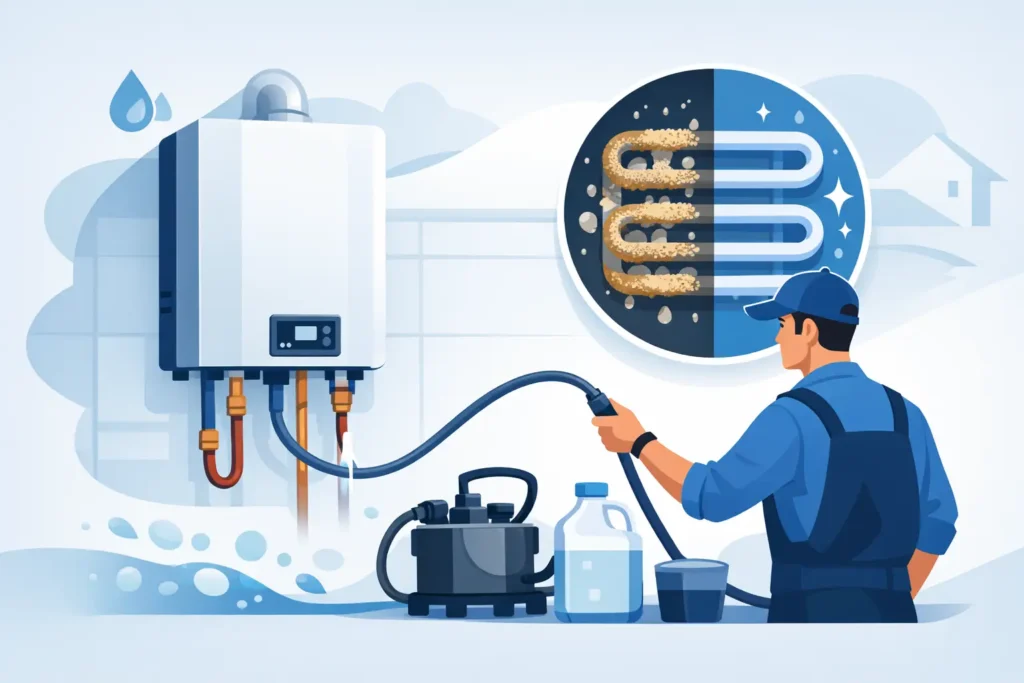
Descaling is more than pouring cleaner into a machine. The unit must be isolated correctly, flushed with a manufacturer-approved descaling solution, and returned to service without leaks or trapped air. The process starts with shutting off the fuel or power source and closing the water valves. A technician connects a pump and hoses to the service ports so the cleaning solution can circulate through the heat exchanger.
The solution dissolves mineral scale that plain water cannot remove. Circulation time varies by the unit and the amount of buildup. Afterward, the heat exchanger is flushed thoroughly with clean water. The technician then restores the water and energy supply, checks connections, and confirms that the heater fires, flows, and operates as it should.
Good maintenance goes beyond the flush. The cold-water inlet filter should be inspected and cleaned. Service valves, pressure relief components, venting connections, and visible plumbing connections should be checked for wear or leaks. If the system has an error history, that should be addressed instead of cleared and forgotten.
At H.I.P. Home Service & Drain, our technicians explain what they find before recommending work. No vague “maintenance package” and no surprise add-ons after we are already in your home. You get a clear price and an honest answer about whether the unit needs a standard descale, a repair, or replacement planning.
Descaling vs. Flushing: They Are Not the Same
Homeowners sometimes use these words interchangeably, but they solve different problems. Flushing generally means moving water through equipment to clear loose sediment or debris. Descaling uses a cleaning solution to break down hardened mineral deposits attached to internal surfaces.
Traditional tank-style water heaters are often flushed to remove sediment that settles at the bottom of the tank. Tankless units do not store water the same way, so their maintenance centers on the heat exchanger and small internal passages. A tankless heater may still need a water filter cleaned and lines inspected, but descaling is the job that targets hard-water buildup.
Can You Descale a Tankless Heater Yourself?
Some tankless models are designed with service valves that make DIY descaling possible. If you are comfortable shutting down gas or electrical equipment, identifying the correct valves, using a circulation pump, and following your manufacturer instructions exactly, it can be a reasonable maintenance project.
There are real trade-offs. Using the wrong cleaner, skipping the final rinse, opening valves in the wrong order, or forcing a stuck connection can create problems that cost more than a service call. Gas units also involve combustion and venting systems that should not be overlooked just because the immediate job is a water flush.
Professional service is usually the better choice when the unit is showing error codes, has not been maintained for several years, is installed in a tight attic or utility space, or has any signs of leaking. It is also the safer call if you are unsure whether the system has isolation valves. A qualified plumber can spot issues around the heater that a basic descale kit will not solve.
Hard Water Protection Can Reduce Future Buildup
Descaling removes existing scale. It does not change the water entering your home tomorrow. If your tankless heater needs frequent cleaning or your fixtures constantly show white mineral residue, ask about water testing and treatment options.
A whole-home water softener can reduce the minerals that form scale, though it is not the right answer for every household. It adds equipment, ongoing salt use, and maintenance. Some homes may be better served by a different filtration or conditioning approach. The goal is not to sell a system you do not need. The goal is to protect plumbing fixtures and appliances based on what your water is actually doing.
Even with water treatment, a tankless heater should still receive regular inspections. Filters clog, valves age, and maintenance records matter if you ever need warranty support. Keeping up with service is cheaper and less disruptive than finding out your hot water is gone on a Saturday morning.
Do Not Let a Small Maintenance Job Become a No-Hot-Water Call
Tankless systems are efficient, compact, and built for long service. They are not maintenance-free. Annual descaling is one of the simplest ways to protect steady hot water, preserve efficiency, and catch small plumbing issues before they turn into a cold-shower emergency.
If your tankless heater is noisy, inconsistent, overdue for maintenance, or showing an error code, get it checked while it is still working. A straightforward service visit now can help keep your home comfortable when your household needs hot water most.